Precise Definition of a Limit
In the previous sections, we discussed limits intuitively. However, the precise definition of a limit can be made more detailed. See the following definition.
Definition:
Let f be a function defined on an open interval that contains a, except at a itself. The limit of f(x) as x approaches a is L:
[latex]lim_{x \rightarrow a}f(x) = L[/latex]
If for every number [latex]\epsilon > 0[/latex] there is a number [latex]\delta > 0[/latex] such that:
If [latex]0 < |x-a| < \delta then |f(x) – L| < \epsilon[/latex]
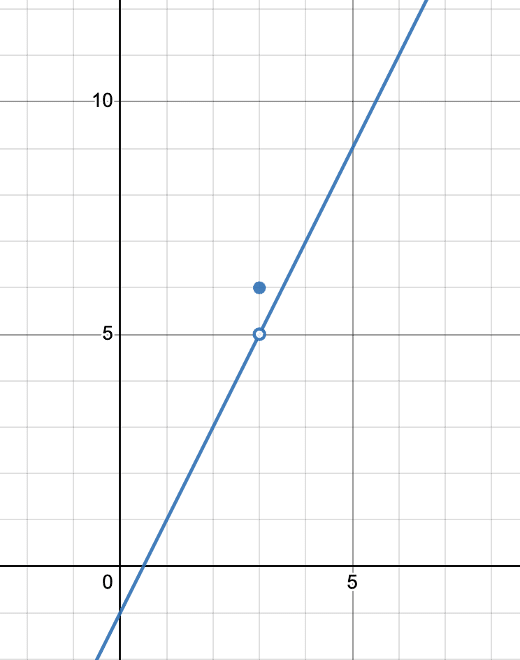
Let’s walk through an example to illustrate the precise definition of a limit concept. Take a look at the function below, which is also graphed as shown.
[latex]f(x) = \left\{\begin{matrix}2x-1, &x\neq 3&\\6,\space\space& x = 3&\end{matrix}\right.[/latex]
We can see that when x is close to 3 but not equal to 3, then f(x) is close to 5. This means that [latex]lim_{x \rightarrow 3}(2x-1) = 5[/latex].
Well, how can we instead use the precise definition of a limit to prove this? The first step is to identify that a = 3 and L = 5. First, let’s say that we want to find how close to 3 does x need to be so that the difference between 5 and f(x) is less than 0.1.
So, from the precise definition of the limit, we need to find a number [latex]\delta > 0[/latex] so that the following is true:
[latex]|f(x) – L| < \epsilon[/latex] when [latex]0 < |x-a| < \delta[/latex]
or
[latex]|f(x) – 5| < 0.1[/latex] when [latex]0 < |x-3| < \delta[/latex]
Continuing along, notice that if [latex]0 < |x-3| < \frac{0.1}{2} = 0.05[/latex] then:
[latex]|f(x) – 5| = |(2x-1) – 5| = |2x-6| = 2|x-3| < 0.1[/latex], so:
[latex]|f(x) – 5| < 0.1[/latex] when [latex]0 < |x-3| < 0.05[/latex]
This means that if x is within a distance of 0.05 from 3, then the value of f(x) will be within a distance of 0.1 from 5.
Now, if we change the number 0.1 to a smaller number such as 0.01 or 0.001, we have:
[latex]|f(x) – 5| < 0.01[/latex] when [latex]0 < |x-3| < 0.005[/latex]
or
[latex]|f(x) – 5| < 0.001[/latex] when [latex]0 < |x-3| < 0.0005[/latex]
Based on this, we find that:
[latex]|f(x) – 5| < \epsilon[/latex] when [latex]0 < |x-3| < \delta = \frac{\epsilon}{2}[/latex]
This is essentially the precise way of saying “the value of f(x) is near 5 when x is near 3. The figure illustrates what we have just discussed.
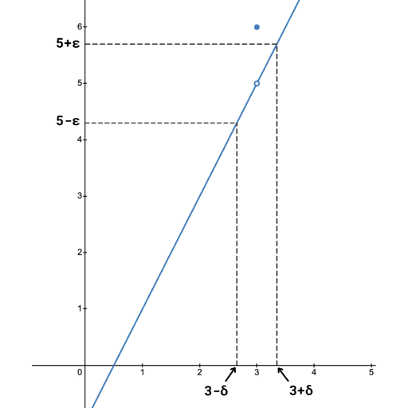
By taking any value of x that lies in between [latex]3 – \delta[/latex] and [latex]3 + \delta[/latex], we can make the values of f(x) lie in between [latex]5 – \epsilon[/latex] and [latex]5+\epsilon[/latex]
Example 6
Using the precise definition a limit, prove the following:
[latex]lim_{x \rightarrow 0}(x^2) = 0[/latex]
Need more explanation? Chat with a tutor now!
QUESTIONS?
If you have any questions about our services or have any feedback, do not hesitate to get in touch with us!