Limits at Infinity
How to find limits at infinity?
In a section prior, we explored the concept of infinite limits. When we let x approach a number, sometimes we found that the value of f(x) became arbitrarily large (approaching infinity).
Now, we are going to let x become arbitrarily large (approach infinity) and investigate the behaviour of f(x).
Limits at infinity take on the following form:
Notation:
[latex]lim_{x \rightarrow \infty}f(x) = L[/latex]
or
[latex]lim_{x \rightarrow -\infty}f(x) = L[/latex]
To explore the concept of infinite limits, let’s look at the behaviour of the function:
[latex]\Large{f(x) = \frac{3x^2+1}{x^2+1}}[/latex]
Similar to what we have done before, we will now let x approach a very large number, and see what happens to the values of f(x). The table shown summarizes this.
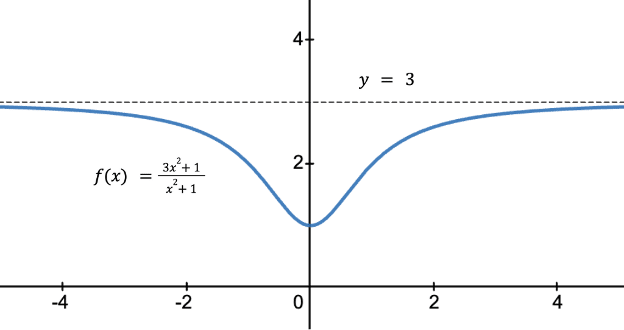
It is very clear that as x approaches a large number, the value of f(x) gets closer and closer to 3. So, we can say that:
[latex]lim_{x \rightarrow \infty}\frac{3x^2+1}{x^2+1} = 3[/latex]
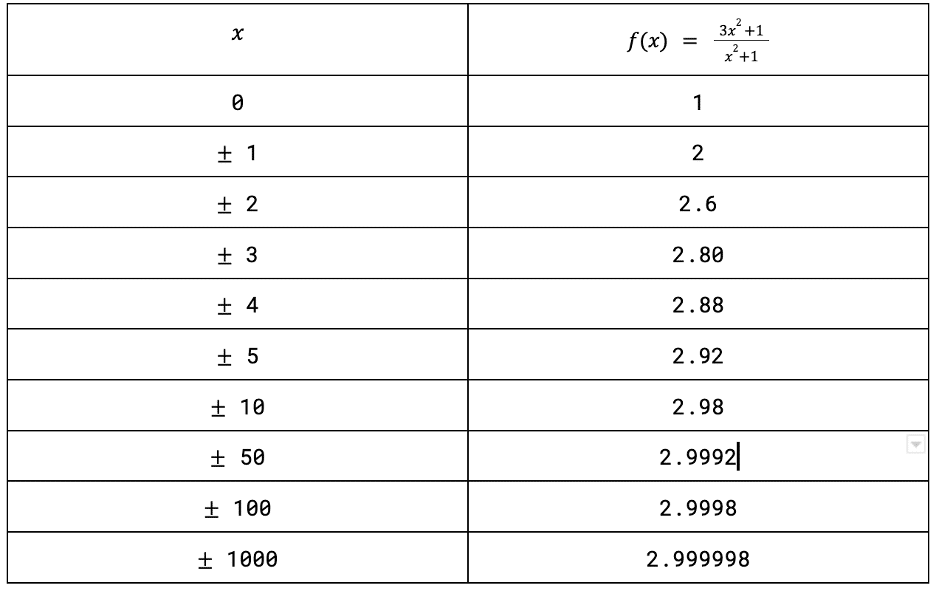
Then, it is clear that the function has a horizontal asymptote at y = 3. This leads us to the definition of the horizontal asymptote, as shown below:
Note:
The line y = L is the horizontal asymptote of f(x) if either:
[latex]lim_{x \rightarrow \infty}f(x) = L[/latex]
or
[latex]lim_{x \rightarrow -\infty}f(x) = L[/latex]
Example 8
Evaluate the following limit:
[latex]\Large{\lim_{x \to \infty}(5x^3-2x^2-6x)}[/latex]
To solve this limit, our first idea would be to substitute [latex]\infty[/latex] into the function and see how it behaves. Well, let’s try that:
[latex]\large{\lim_{x \to \infty}(5x^3-2x^2+6x) = 5(\infty)^3-2(\infty)^2+6(\infty)}[/latex]
[latex]\large{= \infty \:- \infty \:- \infty}[/latex]
Be careful here. You might think the answer is zero or maybe [latex]-\infty[/latex]. However, this is not the correct answer and in fact, this is another one of those indeterminate forms. Hence, we need to solve this limit in a slightly different way.
First, we will factor out the highest degree of [latex]x[/latex] from all of the terms, as follows:
[latex]\large{\lim_{x \to \infty}(5x^3-2x^2-6x) = \lim_{x \to \infty}[x^3\:(5 \:- \frac{2}{x} \:- \frac{6}{x^2})]}[/latex]
We can rewrite this as follows:
[latex]\large{\lim_{x\to \infty}(x^3) \:\cdot\:\lim_{x\to \infty}(5\:-\frac{2}{x}\:-\frac{6}{x^2})}[/latex]
Finally, we have:
[latex]\large{= \infty \:\cdot \: 5 = \infty}[/latex].
Thus,
[latex]\large{\lim_{x\to \infty}(5x^3-2x^2-6x) = \infty}[/latex]
To solve this limit, our first idea would be to substitute [latex]\infty[/latex] into the function and see how it behaves. Well, let’s try that:
[latex]\lim_{x\to \infty}(5x^3-2x^2+6x) = 5(\infty)^3)-2(\infty)^2+6(\infty)[/latex]
[latex]= \infty \:- \infty \:- \infty[/latex]
Be careful here. You might think the answer is zero or maybe [latex]-\infty[/latex]. However, this is not the correct answer and in fact, this is another one of those indeterminate forms. Hence, we need to solve this limit in a slightly different way.
First, we will factor out the highest degree of [latex]x[/latex] from all of the terms, as follows:
[latex]\lim_{x \to \infty}(5x^3-2x^2-6x) = \lim_{x \to \infty}[x^3\:(5 \:- \frac{2}{x} \:- \frac{6}{x^2})][/latex]
We can rewrite this as follows:
[latex]\lim_{x\to \infty}(x^3) \:\cdot\:\lim_{x\to \infty}(5\:-\frac{2}{x}\:-\frac{6}{x^2})[/latex]
Finally, we have:
[latex]\large{= \infty \:\cdot \: 5 = \infty}[/latex].
Thus,
[latex]\large{\lim_{x\to \infty}(5x^3-2x^2-6x) = \infty}[/latex]
Need more explanation? Chat with a tutor now!
QUESTIONS?
If you have any questions about our services or have any feedback, do not hesitate to get in touch with us!