The Definition of the Derivative
What is a derivative?
We will now discuss derivatives and the definition of the derivative, which is a fundamental concept in calculus that will allow us to calculate the rate of change of a function at a specific point.
The derivative of a function f(x) is denoted as a new function f'(x). Using the definition, of the derivative, we have:
Derivative Definition:
[latex]\Large{f'(x) = \lim_{h \to 0}\frac{f(x+h)-f(x)}{h}}[/latex]
Note that the above definition of the derivative essentially stems from the instantaneous rate of change of a function at any given point. Now, let’s use the definition of the derivative to compute the derivative of a simple function, as shown below.
Given [latex]f(x) = 2x^2 +3x -5[/latex] find, [latex]f'(x)[/latex].
The first step is to substitute f(x) into the definition of the derivative as shown:
[latex]\large{f'(x) = \lim_{h \to 0}\frac{f(x+h)-f(x)}{h}}[/latex]
[latex]\large{f'(x) = \lim_{h \rightarrow 0}\frac{2(x+h)^2+3(x+h)-5-(2x^2+3x-5)}{h}}[/latex]
Notice how we cannot simply substitute in h = 0 yet, since this will give us 0/0, which we know as indeterminate form. So first, we must simplify and collect like terms as shown:
[latex]\large{f'(x) = \lim_{h \rightarrow 0}\frac{2x^2+4xh+2h^2+3x+3h-5-2x^2-3x+5}{h}}[/latex]
[latex]\large{f'(x) = \lim_{h \rightarrow 0}\frac{4xh+2h^2+3h}{h}}[/latex]
Now, we can factor our the h from the numerator and then cancel it, as shown:
[latex]\large{f'(x) = \lim_{h \rightarrow 0}\frac{h(4x+2h+3)}{h} = \lim_{h \rightarrow 0}(4x+2h+3)}[/latex]
Finally, we can easily solve the limit and find f'(x) as follows:
[latex]\large{f'(x) = \lim_{h \rightarrow 0}(4x+2h+3) = 4x+2(0)+3}[/latex]
[latex]\large{f'(x) = 4x+3}[/latex]
Take a look at the image below, which compares the function [latex]\large{f(x) = 2x^2+3x-5}[/latex] with its derivative function [latex]\large{f'(x) = 4x+3}[/latex]
Note that the above definition of the derivative essentially stems from the instantaneous rate of change of a function at any given point. Now, let’s use the definition of the derivative to compute the derivative of a simple function, as shown below.
Given [latex]f(x) = 2x^2 +3x -5[/latex] find, [latex]f'(x)[/latex].
The first step is to substitute f(x) into the definition of the derivative as shown:
[latex]f'(x) = \lim_{h \to 0}\frac{f(x+h)-f(x)}{h}[/latex]
[latex]f'(x) = \lim_{h \rightarrow 0}\frac{2(x+h)^2+3(x+h)-5-(2x^2+3x-5)}{h}[/latex]
Notice how we cannot simply substitute in h = 0 yet, since this will give us 0/0, which we know as indeterminate form. So first, we must simplify and collect like terms as shown:
[latex]f'(x) = \lim_{h \rightarrow 0}\frac{2x^2+4xh+2h^2+3x+3h-5-2x^2-3x+5}{h}[/latex]
[latex]f'(x) = \lim_{h \rightarrow 0}\frac{4xh+2h^2+3h}{h}[/latex]
Now, we can factor our the h from the numerator and then cancel it, as shown:
[latex]f'(x) = \lim_{h \rightarrow 0}\frac{h(4x+2h+3)}{h} = \lim_{h \rightarrow 0}(4x+2h+3)[/latex]
Finally, we can easily solve the limit and find f'(x) as follows:
[latex]f'(x) = \lim_{h \rightarrow 0}(4x+2h+3) = 4x+2(0)+3[/latex]
[latex]\large{f'(x) = 4x+3}[/latex]
Take a look at the image below, which compares the function
[latex]\large{f(x) = 2x^2+3x-5}[/latex]
with its derivative function
[latex]\large{f'(x) = 4x+3}[/latex]
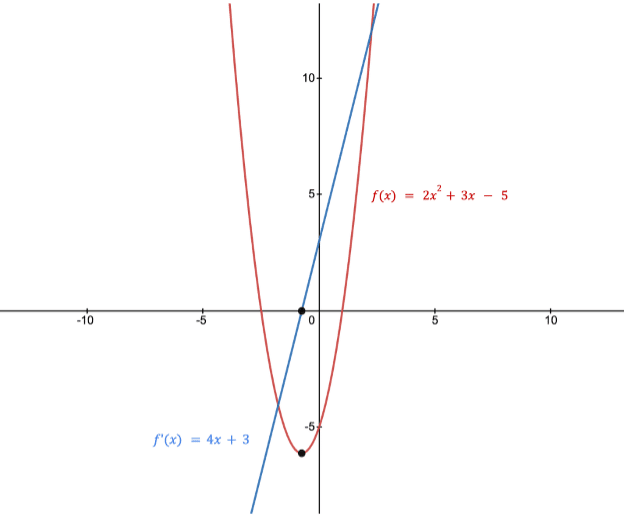
An important concept to take away is that the value of f(x) gives the actual value of the function at any point x. However, the value of f'(x) gives the rate of change of the original function f(x) at a point x. This is illustrated in the graph shown.
We know that at the vertex of a parabola, the rate of change, or slope is zero. The vertex for the function f(x) is located at x = -0.75. If we substitute x = -0.75 into the derivative function, it will give us a value of 0. This is telling us that at x = -0.75, the rate of change of the original function f(x) is zero.
So then, what does it mean for a function to be differentiable at a certain point? See the definition below:
Note:
A function f(x) is said to be differentiable at x = a if:
f'(a) exists.
If f(x) is differentiable at x = a, then f(x) is also continuous at x = a
Example
Using the definition of the derivative, find the derivative of the function:
[latex]\Large{f(x) = \sqrt{x+2}}[/latex]
Step 1:
The definition of the derivative states: [latex]\large{f'(x) = \lim_{h \to 0}\frac{f(x+h) – f(x)}{h}}[/latex]
Substituting the given function into the definition of the derivative, we have:
[latex]\large{f'(x) = \lim_{h \to 0}\frac{\sqrt{x+h+2}-\sqrt{x+2}}{h}}[/latex]
Step 2:
Now, we will multiply both the numerator and denominator by the conjugate:
[latex]\large{f'(x) = \lim_{h \to 0}\frac{\sqrt{x+h+2}-\sqrt{x+2}}{h} \:\cdot\: \frac{\sqrt{x+h+2}+\sqrt{x+2}}{\sqrt{x+h+2}+\sqrt{x+2}}}[/latex]
Simplifying, we have:
[latex]\large{f'(x) = \lim_{h\to 0}\frac{(x+h+2)-(x+2)}{h(\sqrt{x+h+2}+\sqrt{x+2})}}[/latex]
[latex]\large{f'(x) = \lim_{h \to 0}\frac{h}{h(\sqrt{x+h+2}+\sqrt{x+2}} = \lim_{h\to 0}\frac{1}{\sqrt{x+h+2}+\sqrt{x+2}}}[/latex]
Step 3:
Now, we can finally substitute the limit, to find the derivative:
[latex]\large{\lim_{h\to 0}\frac{1}{\sqrt{x+h+2}+\sqrt{x+2}} = \frac{1}{\sqrt{x+0+2}+\sqrt{x+2}}}[/latex]
Thus,
[latex]\large{f'(x) = \frac{1}{2\sqrt{x+2}}}[/latex]
Step 1:
The definition of the derivative states: [latex]\large{f'(x) = \lim_{h \to 0}\frac{f(x+h) – f(x)}{h}}[/latex]
Substituting the given function into the definition of the derivative, we have:
[latex]\large{f'(x) = \lim_{h \to 0}\frac{\sqrt{x+h+2}-\sqrt{x+2}}{h}}[/latex]
Step 2:
Now, we will multiply both the numerator and denominator by the conjugate:
[latex]f'(x) =\small{ \lim_{h \to 0}\frac{\sqrt{x+h+2}-\sqrt{x+2}}{h} \:\cdot\: \frac{\sqrt{x+h+2}+\sqrt{x+2}}{\sqrt{x+h+2}+\sqrt{x+2}}}[/latex]
Simplifying, we have:
[latex]f'(x) = \lim_{h\to 0}\frac{(x+h+2)-(x+2)}{h(\sqrt{x+h+2}+\sqrt{x+2})}[/latex]
[latex]f'(x) = \scriptsize{\lim_{h \to 0}\frac{h}{h(\sqrt{x+h+2}+\sqrt{x+2}} = \lim_{h\to 0}\frac{1}{\sqrt{x+h+2}+\sqrt{x+2}}}[/latex]
Step 3:
[latex]\small{\lim_{h\to 0}\frac{1}{\sqrt{x+h+2}+\sqrt{x+2}} = \frac{1}{\sqrt{x+0+2}+\sqrt{x+2}}}[/latex]
Thus,
[latex]\large{f'(x) = \frac{1}{2\sqrt{x+2}}}[/latex]
Need more explanation? Chat with a tutor now!
QUESTIONS?
If you have any questions about our services or have any feedback, do not hesitate to get in touch with us!