Maximum and Minimum
Maximum and Minimum Values of a Function
A very important use for derivatives is finding the maximum and minimum values of a function. Many times, you may need to figure out the best value for something or the best way to do something. Suppose a business owner wants to know what price to sell a product to maximize their profit, or a farmer wants to know how they can maximize the area of a fencing enclosure. These are all examples of situations where derivatives come into play.
Let’s first define maximum and minimum values:
If [latex]f(c) \ge f(x)[/latex] for all [latex]x[/latex] in the domain of [latex]f[/latex], then [latex]x = c[/latex] is the location of the global maximum of the function f. The maximum value of the function is [latex]f(c)[/latex]
Similiarly, if [latex]f(c) \le f(x)[/latex] for all [latex]x[/latex] in the domain of [latex]f[/latex], then [latex]x = c[/latex] is the location of the global minimum of the function f. The minimum value of the function is then [latex]f(c)[/latex].
Take a look at the graph shown, which outlines the concept of maximum and minimum values of a function.
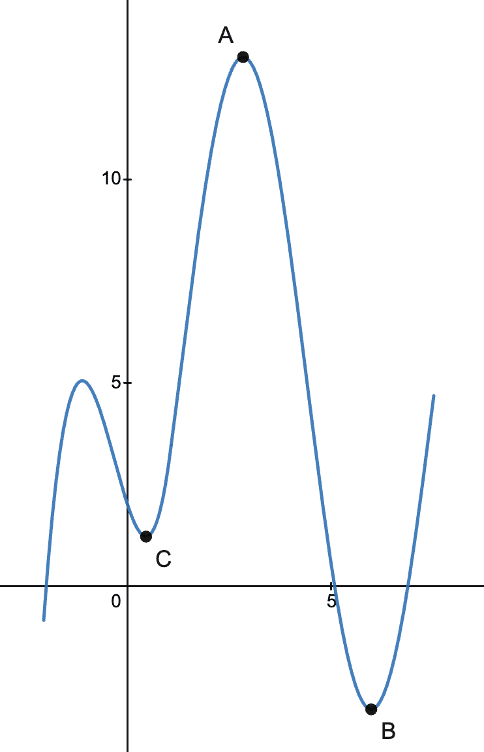
As shown in the graph above, it is clear that the highest point of the function is at point A. Thus, the maximum value of the function is then f(A). Hence, we can say that point A is the global or absolute maximum of the function.
Similarly, the lowest point on the function is point B. Thus, the minimum value of the function is f(B). So, point B would be the global or absolute minimum of the function.
However, what if we only consider the function values in between the interval of x = 0 to x = 5. It is then clear that point C is now the lowest value. This means that of all the values being considered for this specific interval, the value of f(C) is the lowest. Hence, we can say that point C is a local minimum of the function
Critical Points
A critical point on a function refers to a point where the derivative is zero. The concept of critical points can help us locate where the minima and maxima points are on a function. The example below will investigate how the first derivative can be used to find the critical points of a function, which tell us where the extrema (maximum and minimum) values are located.
Example
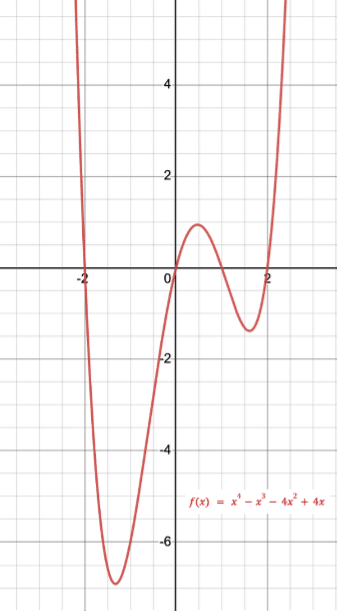
The function [latex]f(x) = x^4-x^3-4x^2+4x[/latex] is shown below. How many local minimum/maximums are there? What about global maximum/minimums?
Example
Find the location of the critical values, for the following function:
[latex]\Large{f(x) = \frac{1}{4}x^4+\frac{5}{3}x^3}+\frac{5}{2}x^2+25x[/latex]
Step 1:
We know that the critical points are located where the derivative is zero or undefined. Hence, we must first find the derivative of the function and set equal to zero, which should be easy for us:
[latex]\large{f'(x) = x^3 +5x^2+5x+ 25 = 0}[/latex]
Step 2:
Now, to solve for x we will need to factor the polynomial. In this case, we can factor by grouping as shown:
[latex]\large{x^2(x+5)+5(x+5) = 0}[/latex]
[latex]\large{(x^2+5)(x+5) = 0}[/latex]
Thus, our critical point is located at: [latex]x = -5[/latex].
Note that we cannot solve [latex]\large{x^2 = -5}[/latex], thus [latex]\large{x = -5}[/latex] is the only solution for the critical point of the given function.
Need more explanation? Chat with a tutor now!
QUESTIONS?
If you have any questions about our services or have any feedback, do not hesitate to get in touch with us!