Area Between Curves
What is the Area Between Curves?
Previously, we discussed definite integrals and how they represent the area under the curve of a function. An important application of integrals is to find the area between curves, which we will now explore.
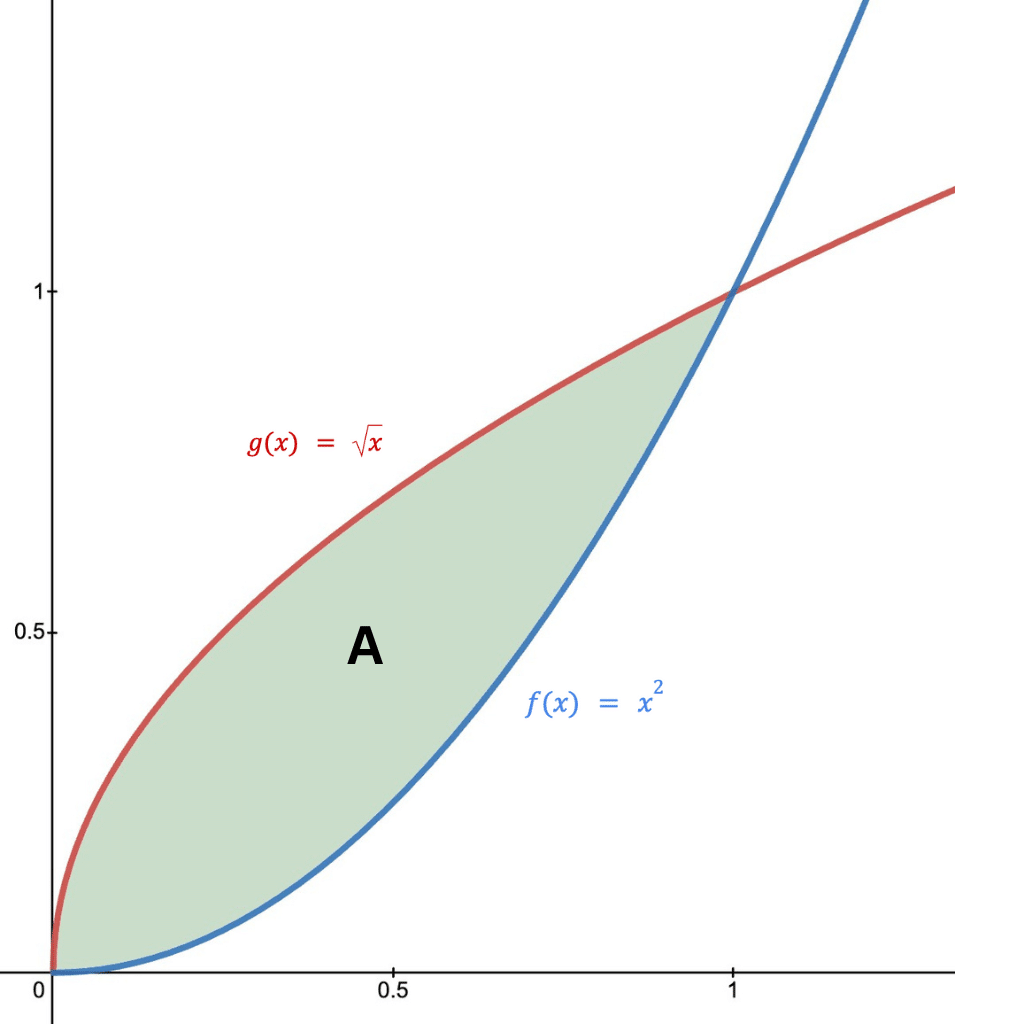
Take a look at the functions [latex]f(x) = x^2[/latex] and [latex]g(x) = \sqrt{x}[/latex] as shown. Notice how there is an enclosed area which is created between the two functions, as indicated by the shaded area A.
We can use our knowledge of definite integrals to determine the value of this shaded area. It is also important to note that the shaded area is bounded between the interval: [latex]0 \le x \le 1[/latex].
The definition below can be used to determine the value of this shaded area:

Note:
[latex]A = \int_{a}^{b}(Upper function - lower function) dx[/latex]
For this definition to be true, both functions must be continuous for all values of x in the specified interval. In our case, the upper function is [latex]g(x) = \sqrt{x}[/latex] and the lower function is [latex]f(x) = x^2[/latex]. Also, the interval is from x = 0, x = 1, so a and b are 0 and 1 respectively.
So, we can determine the area between the two curves as follows:
[latex]\large{A = \int_{a}^{b}g(x) – f(x) \,dx = \int_{0}^{1}\sqrt{x}-x^2 \,dx}[/latex]
This definite integral can now be solved using our knowledge of integration rules that we discussed before. So, we have:
[latex]\large{= \int_{0}^{1}\sqrt{x} – x^2\,dx = \frac{2}{3}x^{\frac{3}{2}}-\frac{1}{3}x^3|_{0}^{1}}[/latex]
[latex] \large{= [\frac{2}{3}(1)^{\frac{3}{2}}-\frac{1}{3}(1)^3] – [\frac{2}{3}(0)^{\frac{3}{2}}-\frac{1}{3}(0)^3] = \frac{1}{3}}[/latex]
Hence, the area of the region between the functions [latex]\sqrt{x}[/latex] and [latex]x^2[/latex] for the interval [latex]0 \le x \le 1[/latex] is [latex]\frac{1}{3}[/latex] units.
Thus, we have explored how the definite integral can be used to find the area between curves.
Example
Find the area of the region between the functions:
[latex]\large{f(x) = \sin(x)}[/latex] and [latex]\large{g(x) = \frac{1}{7}x^2}[/latex]
For the interval: [latex]0 \le x \le 2[/latex]
Step 1:
First, let’s graph the two functions, as shown below:
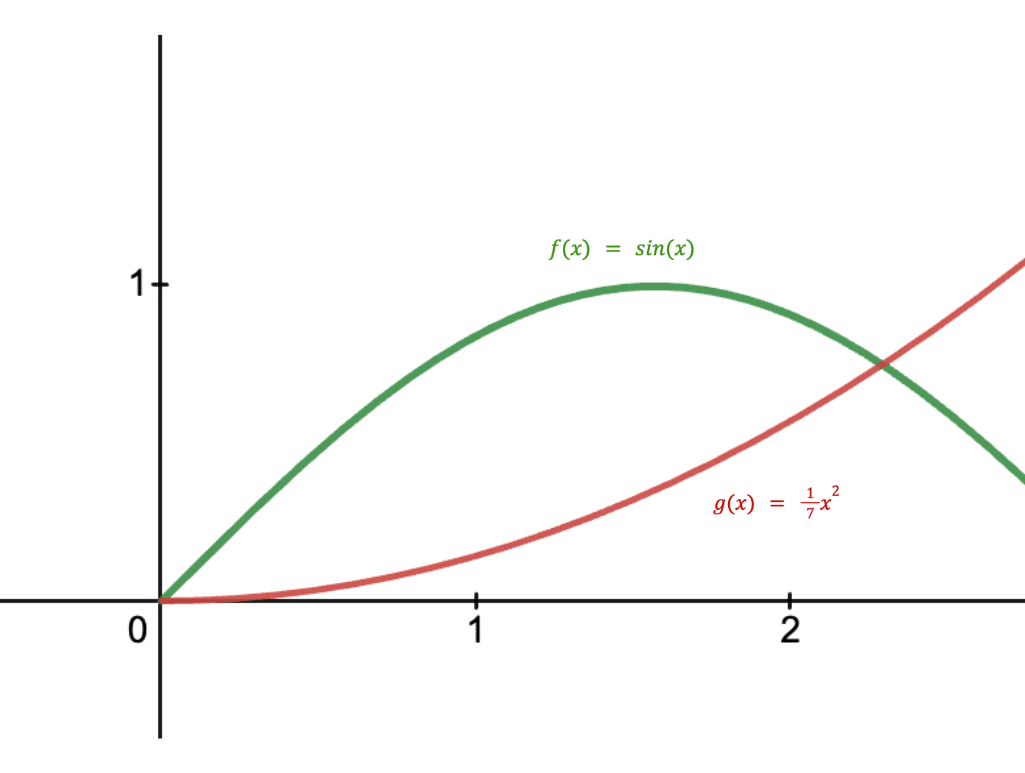
As we can see, it is clear that [latex]f(x) = \sin(x) [/latex] is the upper function and [latex]g(x) = \frac{1}{7}x^2[/latex] is the lower function.
Step 2:
Thus, the area between the functions for the specified interval is:
[latex]\large{\int_{0}^{2}(\sin(x)\: – \:\frac{1}{7}x^2) dx}[/latex]
Step 3:
This definite integral should be easy enough for us to solve. We have:
[latex]\large{\int_{0}^{2}(\sin(x) – \frac{1}{7}x^2) = (-\cos(x) – \frac{1}{21}x^3)|_{0}^{2}}[/latex]
[latex]\large{= [-\cos(2) – \frac{1}{21}(2)^3] \: – \: [-\cos(0) – \frac{1}{21}(0)^3]}[/latex]
Simplifying, we have:
[latex]\large{= -\cos(2) – \frac{8}{21} + 1 = -\cos(2) + \frac{13}{21}}[/latex]
[latex]\large{\approx 1.035}[/latex]

Step 1:
First, let’s graph the two functions, as shown below:

As we can see, it is clear that [latex]f(x) = \sin(x) [/latex] is the upper function and [latex]g(x) = \frac{1}{7}x^2[/latex] is the lower function.
Step 2:
Thus, the area between the functions for the specified interval is:
[latex]\large{\int_{0}^{2}(\sin(x)\: – \:\frac{1}{7}x^2) dx}[/latex]
Step 3:
This definite integral should be easy enough for us to solve. We have:
[latex]\small{\int_{0}^{2}(\sin(x) – \frac{1}{7}x^2) = (-\cos(x) – \frac{1}{21}x^3)|_{0}^{2}}[/latex]
[latex]\small{= [-\cos(2) – \frac{1}{21}(2)^3] \: – \: [-\cos(0) – \frac{1}{21}(0)^3]}[/latex]
Simplifying, we have:
[latex]\small{= -\cos(2) – \frac{8}{21} + 1 = -\cos(2) + \frac{13}{21}}[/latex]
[latex]\large{\approx 1.035}[/latex]

Example
Find the area of the region between the functions:
[latex]\large{f(x) = x^2}[/latex] and [latex]\large{g(x) = 8-x^2}[/latex]
Need more explanation? Chat with a tutor now!
QUESTIONS?
If you have any questions about our services or have any feedback, do not hesitate to get in touch with us!