Solution: One Sided Limits #1
Solution: One Sided Limits #1
The plot of [latex]f(x)[/latex] is shown below. (Not to scale)
For each of the points given below, find [latex]\lim_{x\to a^-}f(x)[/latex], [latex]\lim_{x\to a^+}f(x)[/latex], [latex]\lim_{x\to a}f(x)[/latex], and [latex]f(a)[/latex].
1) [latex]a = 1[/latex]
2) [latex]a = 2[/latex]
3) [latex]a = 3[/latex]
4) [latex]a = 4[/latex]
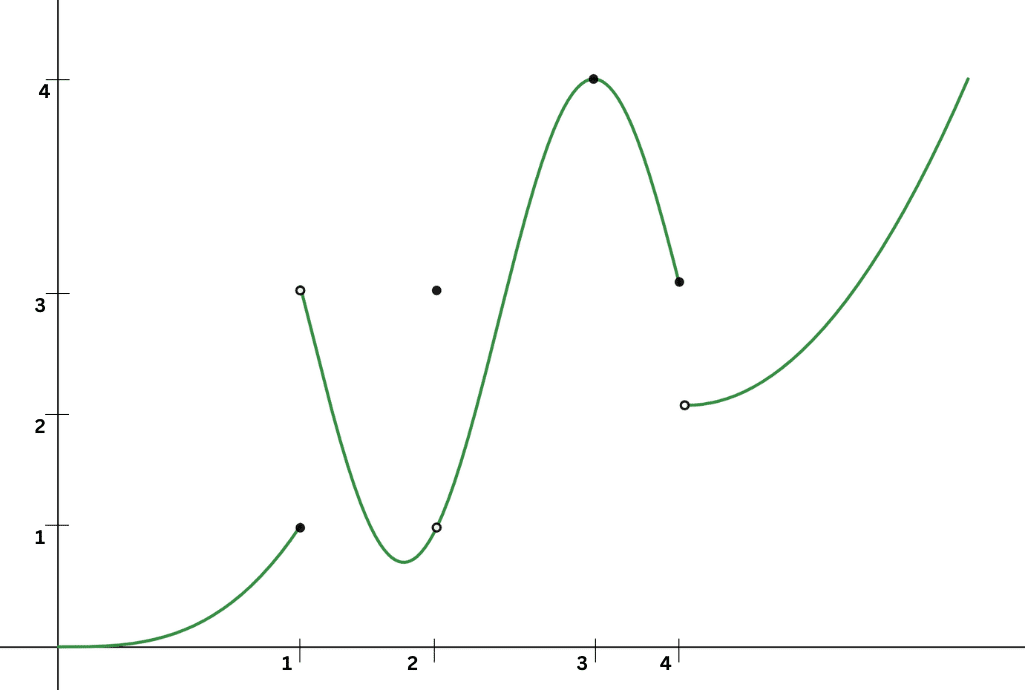
Part 1
If we approach x = 1 from the left side, we can see that the function approaches a value of 1. Thus, we can say that:
[latex]\large{\lim_{x\to 1^-}f(x) = 1}[/latex]
Then, if we approach x = 1 from the right side, we can see that the function approaches a value of 3. So:
[latex]\large{\lim_{x \to 1^+}f(x) = 3}[/latex]
Since the left and right handed limits are different, we know that:
[latex]\large{\lim_{x\to 1}f(x)}[/latex] does not exist!
However, we can see that the function is defined at x = 1 by the solid black dot. Thus:
[latex]\large{f(1) = 1}[/latex].
Part 2
If we approach x = 2 from the left side, we can see that the function approaches a value of 1. Thus, we can say that:
[latex]\large{\lim_{x\to 2^-}f(x) = 1}[/latex]
Then, if we approach x = 2 from the right side, we can see that the function also approaches a value of 1. So:
[latex]\large{\lim_{x \to 2^+}f(x) = 1}[/latex]
Since the left and right handed limits are equal, we can say that:
[latex]\large{\lim_{x\to 2}f(x) = 1}[/latex]
However, what is the value of the function at x = 2? Well, indicated by the solid black dot, we can see that the value is 3. So:
[latex]\large{f(2) = 3}[/latex]
Part 3
If we approach x = 3 from the left side, we can see that the function approaches a value of 4. Thus, we can say that:
[latex]\large{\lim_{x\to 3^-}f(x) = 4}[/latex]
Then, if we approach x = 3 from the right side, we can see that the function also approaches a value of 4. So:
[latex]\large{\lim_{x \to 3^+}f(x) = 4}[/latex]
Since the left and right handed limits are equal, we can say that:
[latex]\large{\lim_{x\to 3}f(x) = 4}[/latex]
However, we can see that the value of the function at x = 3 is also 4! So:
[latex]\large{f(3) = 4}[/latex]
This means that the function is continuous at x = 3!
Part 4
If we approach x = 4 from the left side, we can see that the function approaches a value of 3. Thus, we can say that:
[latex]\large{\lim_{x\to 4^-}f(x) = 3}[/latex]
Then, if we approach x = 4 from the right side, we can see that the function also approaches a value of 2. So:
[latex]\large{\lim_{x \to 4^+}f(x) = 2}[/latex]
Since the left and right handed limits are different, we can say that:
[latex]\large{\lim_{x\to 4}f(x)}[/latex] does not exist!
However, we can see that the value of the function at x = 4 is 3. So:
[latex]\large{f(4) = 3}[/latex]
Solution Complete!
Send us a review!
Solution: One Sided Limits #1
The plot of [latex]f(x)[/latex] is shown below. (Not to scale)
For each of the points given below, find [latex]\lim_{x\to a^-}f(x)[/latex], [latex]\lim_{x\to a^+}f(x)[/latex], [latex]\lim_{x\to a}f(x)[/latex], and [latex]f(a)[/latex].
1) [latex]a = 1[/latex]
2) [latex]a = 2[/latex]
3) [latex]a = 3[/latex]
4) [latex]a = 4[/latex]
Part 1
If we approach x = 1 from the left side, we can see that the function approaches a value of 1. Thus, we can say that:
[latex]\large{\lim_{x\to 1^-}f(x) = 1}[/latex]
Then, if we approach x = 1 from the right side, we can see that the function approaches a value of 3. So:
[latex]\large{\lim_{x \to 1^+}f(x) = 3}[/latex]
Since the left and right handed limits are different, we know that:
[latex]\large{\lim_{x\to 1}f(x)}[/latex] does not exist!
However, we can see that the function is defined at x = 1 by the solid black dot. Thus:
[latex]\large{f(1) = 1}[/latex].
Part 2
If we approach x = 2 from the left side, we can see that the function approaches a value of 1. Thus, we can say that:
[latex]\large{\lim_{x\to 2^-}f(x) = 1}[/latex]
Then, if we approach x = 2 from the right side, we can see that the function also approaches a value of 1. So:
[latex]\large{\lim_{x \to 2^+}f(x) = 1}[/latex]
Since the left and right handed limits are equal, we can say that that:
[latex]\large{\lim_{x\to 2}f(x) = 1}[/latex]
However, what is the value of the function at x = 2? Well, as indicated by the solid black dot, we can see that the value is 3. Thus:
[latex]\large{f(2) = 3}[/latex].
Part 3
If we approach x = 3 from the left side, we can see that the function approaches a value of 4. Thus, we can say that:
[latex]\large{\lim_{x\to 3^-}f(x) = 4}[/latex]
Then, if we approach x = 3 from the right side, we can see that the function also approaches a value of 4. So:
[latex]\large{\lim_{x \to 3^+}f(x) = 4}[/latex]
Since the left and right handed limits are equal, we can say that that:
[latex]\large{\lim_{x\to 3}f(x) = 4}[/latex]
However, we can see that the value of the function at x = 3 is also 4! Thus:
[latex]\large{f(3) = 4}[/latex].
This means that the function is continuous at x = 3.
Part 4
If we approach x = 4 from the left side, we can see that the function approaches a value of 3. Thus, we can say that:
[latex]\large{\lim_{x\to 4^-}f(x) = 3}[/latex]
Then, if we approach x = 4 from the right side, we can see that the function approaches a value of 2. So:
[latex]\large{\lim_{x \to 4^+}f(x) = 2}[/latex]
Since the left and right handed limits are different, we can say that that:
[latex]\large{\lim_{x\to 4}f(x)}[/latex] does not exist!
However, what is the value of the function at x = 4? Well, as indicated by the solid black dot, we can see that the value is 3. Thus:
[latex]\large{f(4) = 3}[/latex].
Solution Complete!
Send us a review!
Need Additional Help? Chat with a tutor now!
QUESTIONS?
If you have any questions about our services or have any feedback, do not hesitate to get in touch with us!