The Definite Integral
At this point, you must be wondering, what exactly is an integral and what does it represent? Essentially, integrals represent the area under a function!
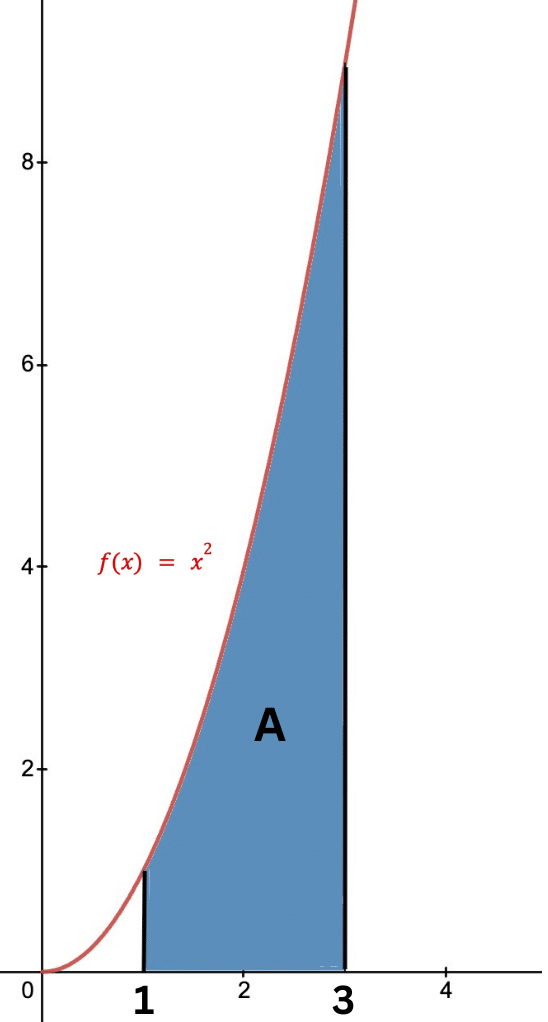
Let’s take a look at a familiar function, [latex]f(x) = x^2[/latex]. Let’s also restrict the domain to [latex]x > 0[/latex]. Also, let’s draw two vertical lines at x = 1 and x = 3.
The area of the shaded region A can be determined using the concept of the definite integral. In fact, this is what the definite integral represents! The definite integral represents the area under the curve of a function [latex]f(x)[/latex], for a specified interval.
The definition of this type of integral is shown below:
Definite Integral:
[latex]\large{\int_{a}^{b}f(x)dx = F(b) – F(a)}[/latex]
Let’s now use this definition to compute the area of the shaded region under the plot of [latex]f(x) = x^2[/latex] for the interval x = 1 to x = 3.
[latex]\large{\int_{1}^{3}x^2 dx = \frac{1}{3}x^3|_{1}^{3} = \frac{1}{3}(3)^3 – \frac{1}{3}(1)^3}[/latex]
[latex]\large{= \frac{27}{3} \: -\: \frac{1}{3} = \frac{26}{3}}[/latex]
This means that the area of the shaded region A as shown in the image above, is [latex]\frac{26}{23}[/latex], or around 8.67 units. Notice how for definite integrals, we do not add the + C.
Example
Evaluate the following integral:
[latex]\Large{\int_{-2}^{4}e^x dx}[/latex]
Step 1:
First we will find the integral as we normally would. We have:
[latex]\large{\int_{-2}^{4}e^x dx = e^x|_{-2}^{4}}[/latex]
Step 2:
Using the definite integral definite, we have:
[latex]\large{e^x|_{-2}^{4} = [e^{4}]\: – \:[e^{-2}]}[/latex]
[latex]\large{= e^{4} \: -\: e^{-2}}[/latex]
Example
Find the area under the curve for the graph of function:
[latex]\Large{f(x) = \ln(x) + x^2}[/latex]
for the interval: [latex]2 \le x \le 3[/latex]
Step 1:
To find the area under the given curve for the specified interval, we need to evaluate the following definite integral:
[latex]\large{\int_{2}^{3}\ln(x) + x^2 dx}[/latex]
Step 2:
Refer to the common integrals cheat sheet, to find the integral of ln(x). Thus, we have:
[latex]\large{\int_{2}^{3}ln(x) + x^2 dx = (x\ln(x) – x + \frac{1}{3}x^3)|_{2}^{3}}[/latex]
Step 3:
Then, using the definite integral definition to evaluate, we have:
[latex]\large{(x\ln(x) – x + \frac{1}{3}x^3)|_{2}^{3} = [(3)\ln(3) – 3 + \frac{1}{3}(3)^3] \: – \: [(2)\ln(2) – 2 + \frac{1}{3}(2)^3]}[/latex]
Simplifying, we have:
[latex]\large{= 3\ln(3) – 3 + 9 – 2\ln(2) + 2 – \frac{8}{3} }[/latex]
[latex]\large{= 3\ln(3) – 2\ln(2) + \frac{16}{3}}[/latex]
Step 1:
To find the area under the given curve for the specified interval, we need to evaluate the following definite integral:
[latex]\large{\int_{2}^{3}\ln(x) + x^2 dx}[/latex]
Step 2:
Refer to the common integrals cheat sheet, to find the integral of ln(x). Thus, we have:
[latex]\small{\int_{2}^{3}ln(x) + x^2 dx = (x\ln(x) – x + \frac{1}{3}x^3)|_{2}^{3}}[/latex]
Step 3:
Then, using the definite integral definition to evaluate, we have:
[latex]\small{(x\ln(x) – x + \frac{1}{3}x^3)|_{2}^{3}}[/latex]
[latex]\small{= [(3)\ln(3) – 3 + \frac{1}{3}(3)^3] \: – \: [(2)\ln(2) – 2 + \frac{1}{3}(2)^3]}[/latex]
Simplifying, we have:
[latex]\small{= 3\ln(3) – 3 + 9 – 2\ln(2) + 2 – \frac{8}{3} }[/latex]
[latex]\small{= 3\ln(3) – 2\ln(2) + \frac{16}{3}}[/latex]
Need more explanation? Chat with a tutor now!
QUESTIONS?
If you have any questions about our services or have any feedback, do not hesitate to get in touch with us!