How to find Limits
Limit Laws
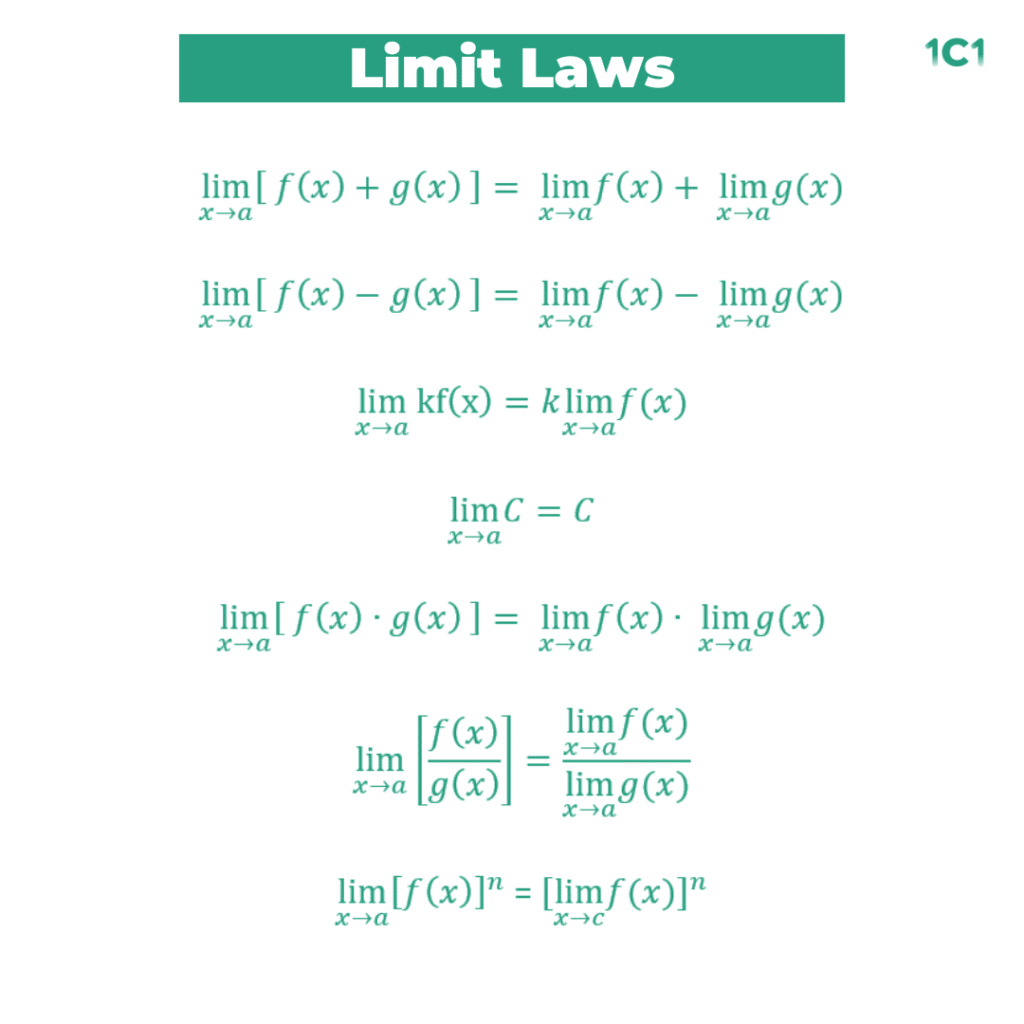
In the previous sections, we used charts and graphs to evaluate limits. However, there are also various limit laws that we can use that will also help us how to find limits.
The various limit laws are shown below. Keep these rules in mind as they will be very helpful when we investigate how to find limits using various methods. Make sure to download a free copy for yourself!
Direct Substitution Method for Solving Limits
One of the most important methods in how to find limits is the direct substitution property. If a is in the domain of f, f being a rational or polynomial function, then the direct substitution proper states that:
Direct Substitution Property:
[latex]lim_{x \rightarrow a}f(x) = f(a)[/latex]
This tells us that many times, the value of the limit as x approaches a is equal to the value of the function at a. This is not always the case however. Let us take a look at the following example:
Evaluate the following limit:
[latex]\Large{\lim_{x \rightarrow 2}\frac{4x^3-12x+3}{x^2-2}}[/latex]
By using the direct substitution property we have just discussed, we have:
[latex]\Large{ \lim_{x \rightarrow 2}\frac{4x^3-12x+3}{x^2-2} = \frac{4(2)^3-12(2)+3}{(2)^2-2}}[/latex]
[latex]\Large{ = \frac{11}{2}}[/latex]
Example 4
Evaluate the following limit:
[latex]\lim_{x \rightarrow 3}(6x^2+5x-4)[/latex]
When evaluating limits, we should always first try substituting the value into the function. For this question, we can easily substitute the value of 3 into the function as shown:
[latex]\large{\lim_{x \to 3}(6x^2+5x-4) = }[/latex]
[latex]\large{6(3)^2+5(3)-4 = 65}[/latex]
See more practice problems like this!
Evaluating limits by Algebraic Manipulation
In many cases, you may find that using the direct substitution method to evaluate a limit may not give you a defined value of f. When this occurs, you will need to rewrite or change the form of the given function and then you will be able to find the limit.
Let’s demonstrate this using the example below.
[latex] \Large{\lim_{x \rightarrow 3}(\frac{x^2-9}{x-3})}[/latex]
So, what happens if we try substituting 3 to find the limit? Well, we end up with [latex]\frac{0}{0}[/latex]. Any time you have [latex]\frac{0}{0}[/latex] or [latex]\frac{\infty}{\infty}[/latex], this is called indeterminate form. An indeterminate form in limits refers to a statement which is not defined. This means that we cannot solve the above limit by direct substitution. We must rewrite in another form, which will give us a defined limit.
First, notice how the numerator can be factored as follows:
[latex]\Large{\lim_{x \rightarrow 3}\frac{(x+3)(x-3)}{x-3}}[/latex]
Now, if we cancel the x – 3 from the numerator and denominator, we can finally find the limit as shown:
[latex]\Large{ \lim_{x \rightarrow 3}(x+3) = 3+3 = 6}[/latex]
Example 5
Evaluate the following limit:
[latex]\lim_{x \to 3}\frac{\sqrt{x+1}-2}{x-3}[/latex]
Step 1:
First, let’s try to directly substitute the limit into the function, as follows:
[latex]\Large{\lim_{x\to 3}(\frac{\sqrt{x+1}-2}{x-3}) = \frac{\sqrt{3+1}-2}{3-3}}[/latex]
[latex]\Large{= \frac{0}{0}}[/latex]
As you can see, we end up with 0/0, which is an indeterminate form. So we must change the original function in a way before solving the limit.
Step 2:
To rewrite the function, we would usually factor either the numerator or denominator, but that does not seem like an option here. Instead, when we are dealing with limits that have roots, we will rationalize by multiplying the numerator and denominator with the conjugate, as shown:
[latex]\Large{\lim_{x \to}(\frac{\sqrt{x+1}-2}{x-3}) = \lim_{x \to 3}(\frac{\sqrt{x+1}-2}{x-3} \cdot \frac{\sqrt{x+1}+2}{\sqrt{x+1}+2})}[/latex]
Using the difference of squares formula to simplify the numerator we have:
[latex]\Large{= \lim_{x \to 3}(\frac{x-3}{(x-3)(\sqrt{x+1}+2)})}[/latex]
Step 3:
Now, we can see that the numerator can be cancelled out. After doing so, we will again finally plug in the limit, to solve it.
[latex]\Large{ = \lim_{x \to 3}(\frac{1}{\sqrt{x+1}+2}) = \frac{1}{\sqrt{3+1}+2} = \frac{1}{4}}[/latex]
Step 1:
First, let’s try to directly substitute the limit into the function, as follows:
[latex]\lim_{x\to 3}(\frac{\sqrt{x+1}-2}{x-3}) = \frac{\sqrt{3+1}-2}{3-3}[/latex]
[latex]= \frac{0}{0}[/latex]
As you can see, we end up with 0/0, which is an indeterminate form. So we must change the original function in a way before solving the limit.
Step 2:
To rewrite the function, we would usually factor either the numerator or denominator, but that does not seem like an option here. Instead, when we are dealing with limits that have roots, we will rationalize by multiplying the numerator and denominator with the conjugate, as shown:
[latex]\lim_{x \to}(\frac{\sqrt{x+1}-2}{x-3})[/latex]
[latex]= \lim_{x \to 3}(\frac{\sqrt{x+1}-2}{x-3} \cdot \frac{\sqrt{x+1}+2}{\sqrt{x+1}+2})[/latex]
Using the difference of squares formula to simplify the numerator we have:
[latex]= \lim_{x \to 3}(\frac{x-3}{(x-3)(\sqrt{x+1}+2)})[/latex]
Step 3:
Now, we can see that the numerator can be cancelled out. After doing so, we will again finally plug in the limit, to solve it.
[latex] = \lim_{x \to 3}(\frac{1}{\sqrt{x+1}+2}) = \frac{1}{\sqrt{3+1}+2} = \frac{1}{4}[/latex]
Need more explanation? Chat with a tutor now!
QUESTIONS?
If you have any questions about our services or have any feedback, do not hesitate to get in touch with us!