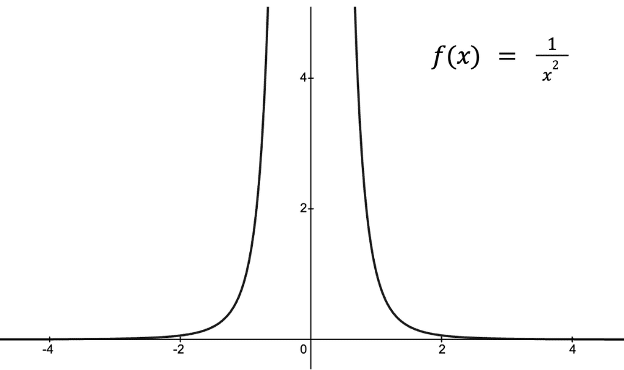
Let us first graph the function [latex]f(x) = \frac{1}{x}[/latex], as shown below.

Part a:
From the graph, we can see that if we approach 0 from the left side of the function, the value of the function approaches a large value in the negative direction, and continues to do so as we keep approaching zero. Thus, it is clear that:
[latex]\Large{\lim_{x \to 0^-}(\frac{1}{x}) = -\infty}[/latex]
Part b:
Similarly, if we approach 0 from the right side, the value of the function approaches a large number in the positive direction, or, positive infinity. Thus:
[latex]\Large{\lim_{x\to 0^+}(\frac{1}{x}) = \infty}[/latex]
Part c:
We know that if the left hand limit and the right hand limit at a given point are different, then the overall limit at that point does not exist. To summarize this idea, since:
[latex]\Large{\lim_{x \to 0^-}(\frac{1}{x}) \neq \lim_{x \to 0^+}(\frac{1}{x}) }[/latex]
Then:
[latex]\Large{\lim_{x \to 0}(\frac{1}{x})}[/latex] does not exist!
Click to see more practice problems like this!
Let us first graph the function [latex]f(x) = \frac{1}{x}[/latex], as shown below.
Part a:
From the graph, we can see that if we approach 0 from the left side of the function, the value of the function approaches a large value in the negative direction, and continues to do so as we keep approaching zero. Thus, it is clear that:
[latex]\Large{\lim_{x \to 0^-}(\frac{1}{x}) = -\infty}[/latex]
Part b:
Similarly, if we approach 0 from the right side, the value of the function approaches a large number in the positive direction, or, positive infinity. Thus:
[latex]\large{\lim_{x\to 0^+}(\frac{1}{x}) = \infty}[/latex]
Part c:
We know that if the left hand limit and the right hand limit at a given point are different, then the overall limit at that point does not exist. To summarize this idea, since:
[latex]\large{\lim_{x \to 0^-}(\frac{1}{x}) \neq \lim_{x \to 0^+}(\frac{1}{x}) }[/latex]
Then:
[latex]\large{\lim_{x \to 0}(\frac{1}{x})}[/latex] does not exist!
See More practice problems like this!