Evaluating Integrals
Integral Rules
In the previous section, we discussed antiderivatives and indefinite integrals, and how the integration power rule can be used to find the integral of polynomial functions.
Similar to derivatives, there is a list of integration formulas and rules which will be quite useful when evaluating integrals. Also, there are many common integrals that you may come across often, which will be useful to remember.
These rules and common integrals are shown. Make sure to receive a free copy for yourself!
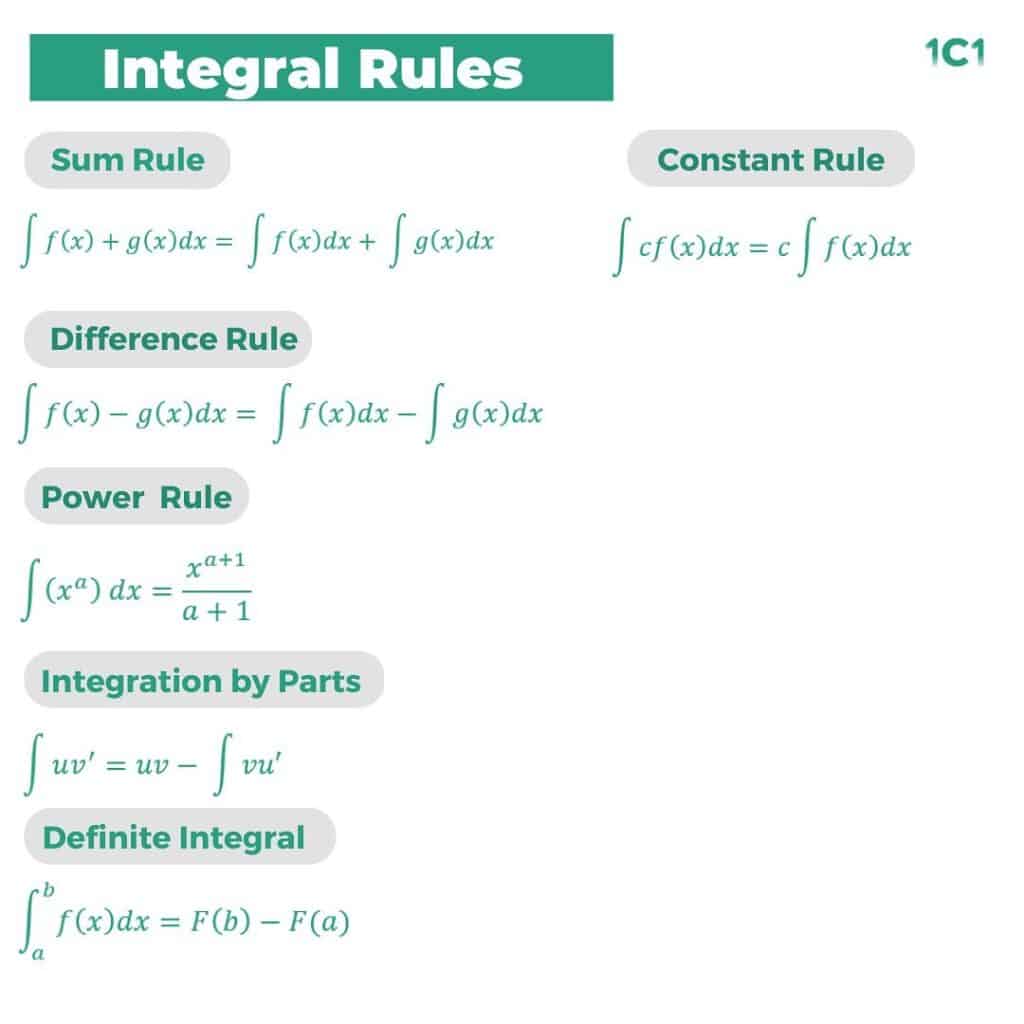
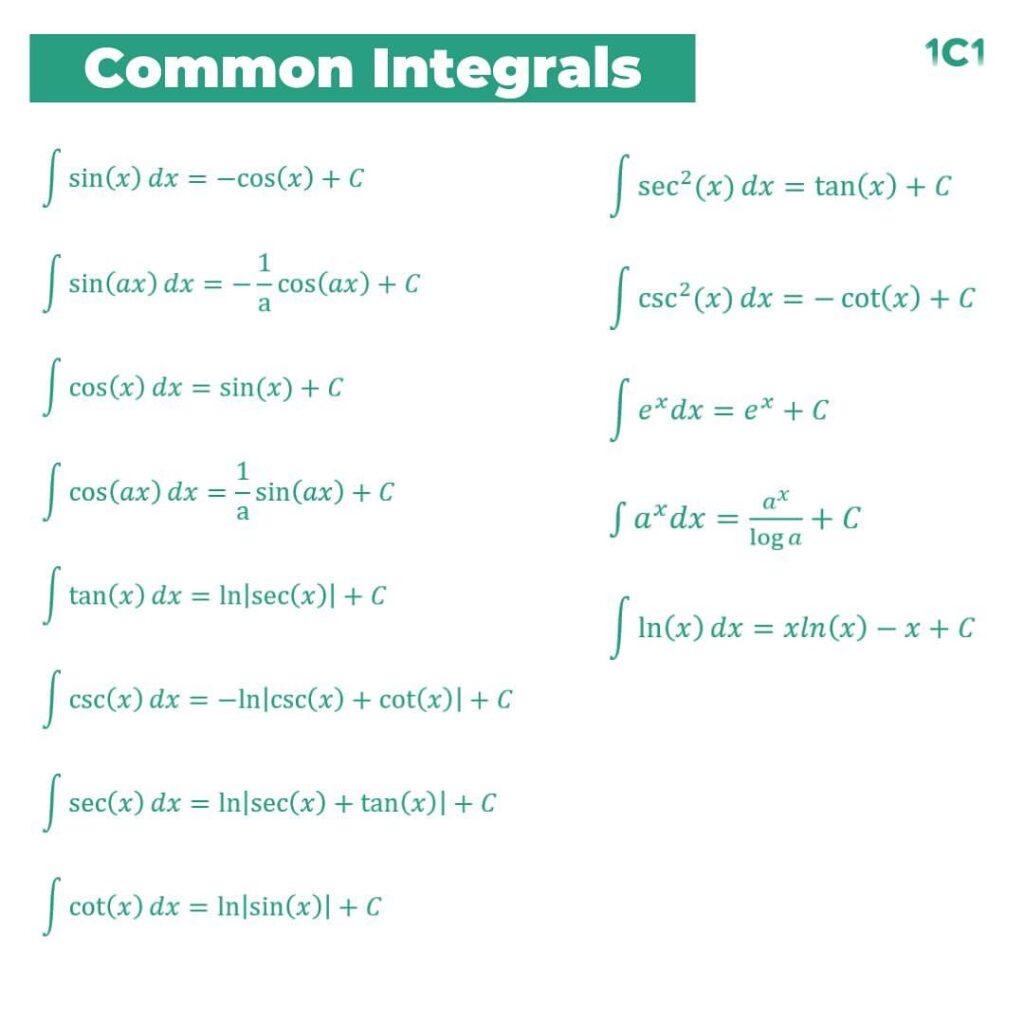
We will now use these rules and common integrals to solve the following question.
Suppose we have a polynomial function give as:
[latex]f(x) = 6x^7-3x^4+2x^3+4x-1[/latex]
So, let’s see how we can solve the following integral:
[latex]\int (6x^7-3x^4+2x^3+4x-1) dx[/latex]
First, by using the sum/difference rule, we can integrate each term alone, as shown:
[latex]\int (6x^7-3x^4+2x^3+4x-1) dx = \int 6x^7 dx – \int 3x^4 dx + \int 2x^3 dx + \int 4x dx – \int 1 dx[/latex]
Now, using the integration power rule as discussed before, we can find the integral of each term separately, as shown:
[latex]\int 6x^7 dx = \frac{6x^8}{8} = \frac{3}{4}x^8 [/latex]
[latex]-\int 3x^4 dx = -\frac{3}{5}x^5 [/latex]
[latex]\int 2x^3 dx = \frac{2x^4}{4} = \frac{1}{2}x^4 [/latex]
[latex]\int 4x dx = \frac{4x^2}{2} = 2x^2 [/latex]
[latex]-\int 1 dx = -x [/latex]
Now, combining all the terms will give us the final answer. Remember, since we are evaluating an indefinite integral, don’t forget to add the + C.
[latex]\int (6x^7-3x^4+2x^3+4x-1) dx = \frac{3}{4}x^8 – \frac{3}{5}x^5 + \frac{1}{2}x^4 + 2x^2 – x + C[/latex]
We will now use these rules and common integrals to solve the following question.
Suppose we have a polynomial function given as:
[latex]f(x) = 6x^7-3x^4+2x^3+4x-1[/latex]
So, let’s see how we can solve the following integral:
[latex]\int (6x^7-3x^4+2x^3+4x-1) dx[/latex]
First, by using the sum/difference rule, we can integrate each term alone, as shown:
[latex]\int(6x^7-3x^4+2x^3+4x-1)dx = \int 6x^7 dx – \int 3x^4 dx + \int 2x^3dx + \int 4x dx – \int 1 dx[/latex]
Now, using the integration power rule as discussed before, we can find the integral of each term separately, as shown:
[latex]\int 6x^7 dx = \frac{6x^8}{8} = \frac{3}{4}x^8 [/latex]
[latex]-\int 3x^4 dx = -\frac{3}{5}x^5 [/latex]
[latex]\int 2x^3 dx = \frac{2x^4}{4} = \frac{1}{2}x^4 [/latex]
[latex]\int 4x dx = \frac{4x^2}{2} = 2x^2 [/latex]
[latex]-\int 1 dx = -x [/latex]
Now, combining all the terms will give us the final answer. Remember, since we are evaluating an indefinite integral, don’t forget to add the + C.
[latex]\int (6x^7-3x^4+2x^3+4x-1) dx = \frac{3}{4}x^8 – \frac{3}{5}x^5 + \frac{1}{2}x^4 + 2x^2 – x + C[/latex]
Example
Evaluate the following integral:
[latex]\Large{\int x^2 + \sin(x) dx}[/latex]
Step 1:
Using the sum rule, we can integrate each term individually as follows:
[latex]\large{\int{x^2 + \sin(x)}dx = \int{x^2}dx + \int{\sin(x)}dx}[/latex]
Step 2:
Now, using our knowledge of the integral power rule and antiderivatives, we can find each integral as follows:
[latex]\large{\int{x^2}dx = \frac{1}{3}x^3}[/latex]
and
[latex]\large{\int{\sin(x)}dx = -\cos(x)}[/latex]
Step 3:
Combining the terms, we have:
[latex]\large{\int{x^2+\sin(x)}dx = \frac{1}{3}x^3 – \cos(x) + C}[/latex]
Step 1:
Using the sum rule, we can integrate each term individually as follows:
[latex]\small{\int{x^2 + \sin(x)}dx = \int{x^2}dx + \int{\sin(x)}dx}[/latex]
Step 2:
Now, using our knowledge of the integral power rule and antiderivatives, we can find each integral as follows:
[latex]\large{\int{x^2}dx = \frac{1}{3}x^3}[/latex]
and
[latex]\large{\int{\sin(x)}dx = -\cos(x)}[/latex]
Step 3:
Combining the terms, we have:
[latex]\large{\int{x^2+\sin(x)}dx = \frac{1}{3}x^3 – \cos(x) + C}[/latex]
Example
Evaluate the following integral:
[latex]\Large{\int e^x -4x^3 + \cos(x) dx}[/latex]
Step 1:
This problem is not so bad. Using the, sum/difference rule we can integrate each term individually as follows:
[latex]\large{\int{e^x \:-\: 4x^3 + \cos(x)}dx = \int{e^x}dx \:-\: \int{4x^3}dx + \int{\cos(x)}dx}[/latex]
Step 2:
These individual integrals should be easy enough for us to determine at this point. We have:
[latex]\large{\int{e^x}dx = e^x}[/latex]
and
[latex]\large{\int{4x^3}dx = x^4}[/latex]
and
[latex]\large{\int{\cos(x)}dx = \sin(x)}[/latex]
Step 3:
Combining the terms, we have:
[latex]\large{\int{e^x-ex^3+\cos(x)}dx = e^x \:-\: x^4 + \sin(x) + C}[/latex]
Step 1:
This problem is not so bad. Using the, sum/difference rule we can integrate each term individually as follows:
[latex]\int{e^x \:-\: 4x^3 + \cos(x)}dx = \int{e^x}dx – \int{4x^3}dx + \int{\cos(x)}dx[/latex]
Step 2:
These individual integrals should be easy enough for us to determine at this point. We have:
[latex]\large{\int{e^x}dx = e^x}[/latex]
and
[latex]\large{\int{4x^3}dx = x^4}[/latex]
and
[latex]\large{\int{\cos(x)}dx = \sin(x)}[/latex]
Step 3:
Combining the terms, we have:
[latex]\int{e^x-ex^3+\cos(x)}dx = e^x \:-\: x^4 + sin(x) + C[/latex]
Example
Evaluate the following integral:
[latex]\Large{\int (3^x + \tan(x)) dx}[/latex]
This integral may seem challenging at first, but we can refer to our common integrals cheat sheet to help us.
Step 1:
First, applying the sum rule, we have:
[latex]\large{\int{3^x + \tan(x)}dx = \int{3^x}dx + \int{\tan(x)}dx }[/latex]
Step 2:
We can determine these integrals to be:
[latex]\large{\int{3^x}dx = \frac{3^x}{\ln(3)}}[/latex]
and
[latex]\large{\int{\tan(x)}dx = \ln|sec(x)|}[/latex]
Step 3:
Combining everything, we have:
[latex]\large{\int{3^x + \tan(x)}dx = \frac{3^x}{\ln(3)} + \ln|\sec(x)| + C}[/latex]
This integral may seem challenging at first, but we can refer to our common integrals cheat sheet to help us.
Step 1:
First, applying the sum rule, we have:
[latex]\small{\int{3^x + \tan(x)}dx = \int{3^x}dx + \int{\tan(x)}dx }[/latex]
Step 2:
We can determine these integrals to be:
[latex]\large{\int{3^x}dx = \frac{3^x}{\ln(3)}}[/latex]
and
[latex]\large{\int{\tan(x)}dx = \ln|sec(x)|}[/latex]
Step 3:
Combining everything, we have:
[latex]\small{\int{3^x + \tan(x)}dx = \frac{3^x}{\ln(3)} + \ln|\sec(x)| + C}[/latex]
Need more explanation? Chat with a tutor now!
QUESTIONS?
If you have any questions about our services or have any feedback, do not hesitate to get in touch with us!