Exponential Functions & Logarithmic Functions
What is an Exponential Function?
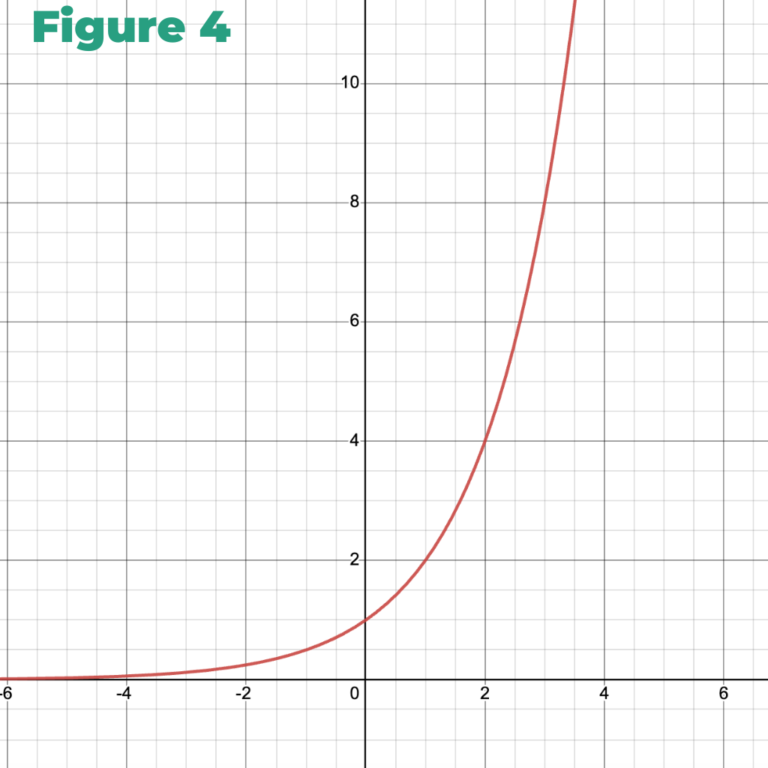
Exponential functions take on the form [latex] \bf{f(x) = (a)^x}[/latex] where a represents a constant which is not equal to 1. Take a look at figure 4, which represents the exponential function [latex] \bf{f(x) = (2)^x}[/latex].
The value of the constant a is very important in determining the behaviour of the function. A value of a > 1 represents exponential growth. However, a value of a between 0 and 1 represents exponential decay.
It can be observed that the x-axis serves as a horizontal asymptote for exponential functions. This means that the value of the function must always be greater than zero. This gives us insight to the domain and range of the function.
The domain of exponential functions is all real numbers.
The range of an exponential function in the form [latex]\bf{(a)^x}[/latex] is y>0.
What is a logarithmic function?
Logarithmic functions are essentially the inverse of exponential functions. They describe the relationship between the exponent and the base in an exponential expression.
A general logarithmic function takes on the form [latex]\bf{f(x) = \log_{a}(x)} [/latex]. It is essential to understand logarithmic functions as it will help when evaluation solving equations involving exponents.
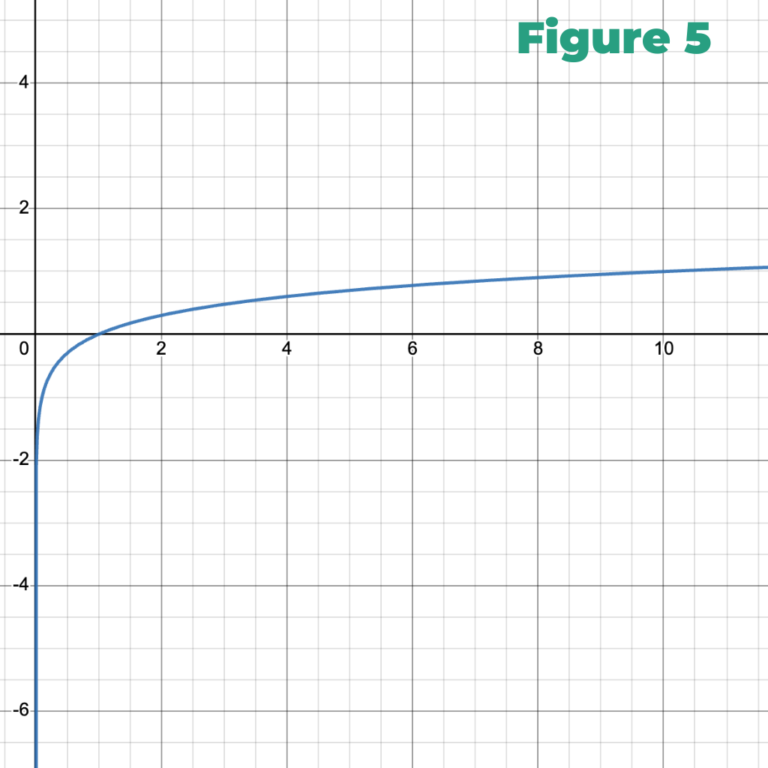
As observed by the plot of [latex]\bf{f(x) = log(x)}[/latex] shown on the right, it can be seen that the vertical y axis serves as a vertical asymptote.
The domain of log functions in the form [latex]\bf{log(x)}[/latex] is all real numbers, but x>0.
The range is all real numbers.
Need more explanation? Chat with a tutor now!
QUESTIONS?
If you have any questions about our services or have any feedback, do not hesitate to get in touch with us!