One Sided Limits
What are One Sided Limits?
You might have noticed by now that we consider the behaviour of the function at a point a, as x approaches it from both sides, that is, the left and the right side.
Many times, you may find that a function approaches a different value when you approach the point from the left side and a different value when you approach it from the right side. The left and right handed limits are expressed using the following notation for one sided limits:
Notation:
Left Handed Limits: [latex]\lim_{x\rightarrow a^-}f(x)= L[/latex]
Right Handed Limits: [latex]\lim_{x\rightarrow a^+}f(x) = L[/latex]
For the above notation, the left handed limit is read as “the limit of f(x) as x approaches a from the left side is equal to L. Similarly, the right handed limit is read as “the limit of f(x) as x approaches a from the right side is equal to L.
In other words, [latex]x\rightarrow a^-[/latex] means we are only considering values of x which are less than a and [latex]x\rightarrow a^+[/latex] means we only consider values of x greater than a. The
The following definition is important to note.
Definition:
[latex]\lim_{x\to a}f(x) = L[/latex]
if and only if
[latex]\lim_{x\to a^-}f(x) = L[/latex] and [latex]\lim_{x\to a^+}f(x) = L[/latex]
This means that the limit as x approaches a exists only if the left and right handed limits are equal. As we discussed before, the function may approach different values when a point is approached from either side, and if this occurs the limit does not exist at that point.
Example 2
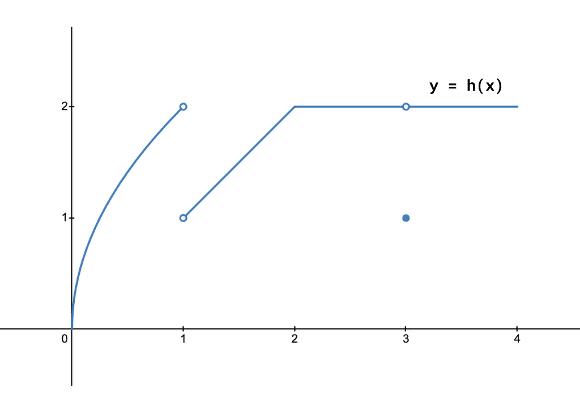
The graph of the function y = h(x) is shown below. State the value of the limits (if they exist) by using the graph.
(a) [latex]\lim_{x\to 1^-}h(x)[/latex] (d) [latex]\lim_{x\to 3^-}h(x)[/latex]
(b) [latex]\lim_{x\to 1^+}h(x)[/latex] (e) [latex]\lim_{x\to 3^+}h(x)[/latex]
(c) [latex]\lim_{x\to 1}h(x)[/latex] (f) [latex]\lim_{x\to 3}h(x)[/latex]
Part a:
Based on the graph, we can see that as we approach the point x = 1, from the left side, it is clear that the function approaches 2. Remember, when dealing with limits, we are not concerned with the value of the function at the point, only what value it is approaching.
Hence, using limit notation, we have:
[latex]\Large{\lim_{x\to 1^-}h(x) = 2}[/latex]
Part b:
Similarly, if we approach x = 1, from the right side, we can see that the function approaches a value of 1. Hence, we have:
[latex]\Large{\lim_{x\to 1^+}h(x) = 1}[/latex]
Part c:
We notice that the left side and right side limits at x = 1 are different. Since this is the case, we can say that:
[latex]\Large{\lim_{x \to 1}h(x)}[/latex] does not exist.
Part d:
Based on the graph, if we approach x = 3 from the left side, we can see that the function approaches 2. So, the answer is:
[latex]\Large{\lim_{x \to 3^-}h(x) = 2}[/latex]
Part e:
Similarly, if we approach x = 3 from the right side, we can also see that the function approaches 2.
[latex]\Large{\lim_{x \to 3^+}h(x) = 2}[/latex]
Part f:
Since in this case, the left and right handed limits are equal at point x = 3, we can say that the overall limit of the function as x approaches 3, is equal to 2 as well.
[latex]\Large{\lim_{x \to 3}h(x) = 2}[/latex]
Part a:
Based on the graph, we can see that as we approach the point x = 1, from the left side, it is clear that the function approaches 2. Remember, when dealing with limits, we are not concerned with the value of the function at the point, only what value it is approaching.
Hence, using limit notation, we have:
[latex]\Large{\lim_{x\to 1^-}h(x) = 2}[/latex]
Part b:
Similarly, if we approach x = 1, from the right side, we can see that the function approaches a value of 1. Hence, we have:
[latex]\Large{\lim_{x\to 1^+}h(x) = 1}[/latex]
Part c:
We notice that the left side and right side limits at x = 1 are different. Since this is the case, we can say that:
[latex]\Large{\lim_{x \to 1}h(x)}[/latex] does not exist.
Part d:
Based on the graph, if we approach x = 3 from the left side, we can see that the function approaches 2. So, the answer is:
[latex]\Large{\lim_{x \to 3^-}h(x) = 2}[/latex]
Part e:
Similarly, if we approach x = 3 from the right side, we can also see that the function approaches 2.
[latex]\Large{\lim_{x \to 3^+}h(x) = 2}[/latex]
Part f:
Since in this case, the left and right handed limits are equal at point x = 3, we can say that the overall limit of the function as x approaches 3, is equal to 2 as well.
[latex]\Large{\lim_{x \to 3}h(x) = 2}[/latex]
Need more explanation? Chat with a tutor now!
QUESTIONS?
If you have any questions about our services or have any feedback, do not hesitate to get in touch with us!